



Which advances are set to transform the future of orthodontics? The American Association of Orthodontists (AAO) Annual Session 2026, held May 1–3 in Orlando, Florida, brought together thousands of orthodontic professionals around the world. As one of the most empowering events for orthodontists and their teams, it featured programs on Innovation & Tech, Clinical Techniques, Scientific Advances, Business Success, and Personal & Professional Growth, alongside more than 350 exhibitors showcasing the latest research and cutting-edge products.
In this special issue of IOF Spotlight, we highlight key trends and insights from AAO 2026 for IOF Circle members. We are honored to feature insights from three distinguished global orthodontic experts who attended the conference in person—Prof. Peter Ngan of West Virginia University, Prof. Ching-Chang Ko of The Ohio State University, and Prof. Chung How Kau of the University of Alabama at Birmingham. Drawing on firsthand experience on-site and evidence-based research, they provide professional interpretations of the most transformative advances shaping the future of orthodontics.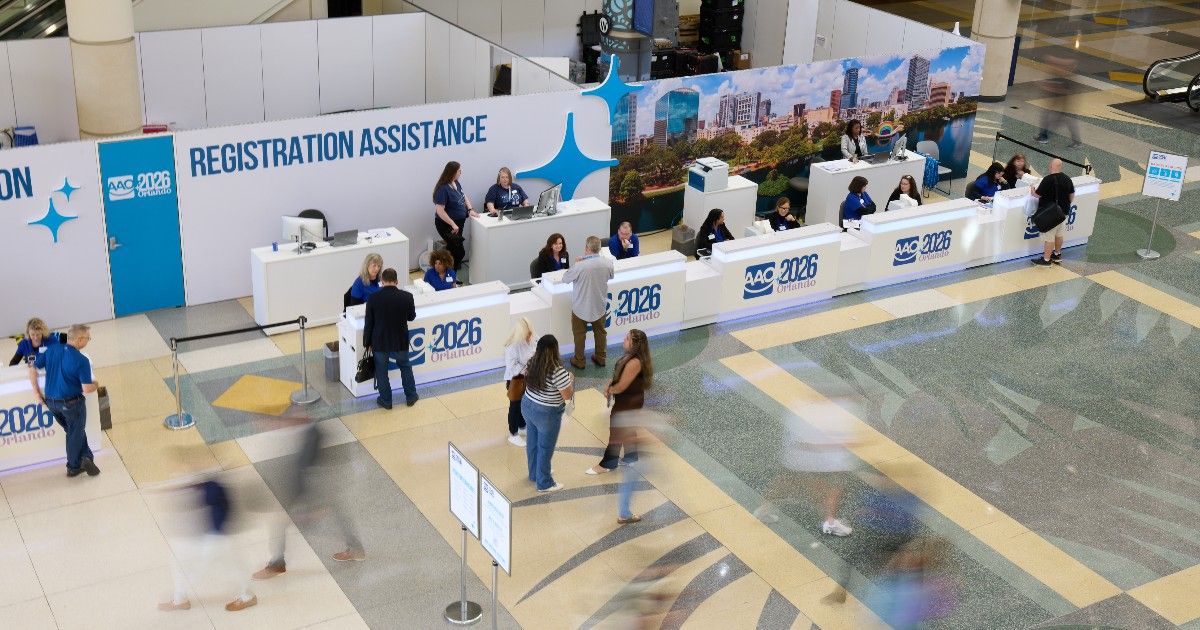
AI Is Moving Beyond Hype Toward Real Clinical Utility
Across the AAO 2026 meeting, AI was no longer discussed as a futuristic concept, but increasingly as a practical clinical and operational tool. The experts agreed that current AI applications are beginning to demonstrate meaningful value in growth prediction, treatment simulation, digital workflows, and clinical efficiency. Prof. Peter Ngan emphasized the importance of distinguishing truly transformative AI applications from technologies driven primarily by hype, particularly those lacking measurable tangible benefit. Prof. Ngan equally stressed that data transparency, ethical implementation, and cost-effectiveness must accompany any clinically meaningful AI deployment. Prof. Ching-Chang Ko noted that predictive AI combined with CAD systems already shows clear promise, though full clinical automation remains far from reality. Meanwhile, Prof. Chung How Kau highlighted AI's emerging role in automating repetitive 'workplace' tasks and supporting clinical delivery, while stressing that AI should remain an adjunct to clinical expertise rather than a replacement. Together, the experts viewed AI as entering a transitional phase from conceptual enthusiasm toward cautious but meaningful integration into orthodontic practice.
Clear Aligner Therapy Is Becoming Increasingly Biomechanics-Driven
The discussion around aligner therapy at AAO 2026 reflected a major shift toward biomechanical precision and treatment predictability. The experts highlighted that clinicians now possess a much deeper understanding of aligner biomechanics than in previous decades. Prof. Chung How Kau pointed to advances in material science, variable-thickness aligners, and attachment auxiliaries that allow improved root control and force delivery. Prof. Peter Ngan emphasized that ideal force systems, attachment design, hybrid mechanics, and the use of auxiliaries such as TADs are becoming central to modern aligner therapy. Prof. Ko added that hybrid therapy combining aligners represented one of the most important developments showcased this year. Collectively, the experts agreed that future progress in aligner therapy will depend less on marketing innovation and more on achieving reliable, evidence-based biomechanical control.
Direct-Printed Aligners Show Promise — But Evidence Still Lags Behind Expectations
Direct-printed aligners (DPA) attracted considerable attention at AAO 2026. Prof. Chung How Kau noted that conventional thermoformed aligners (CTA) already occupy 30%–40% of clinical workspace in orthodontics, meaning DPA must demonstrate clinical outcomes that are at least equivalent — if not superior — to existing systems. While material innovations and customized thickness control offer significant theoretical advantages, the experts emphasized that laboratory standardization, workflow consistency, and long-term clinical predictability are still in their infancy. Although DPA is increasingly viewed as a potentially transformative technology, the consensus among the experts was that the field is still in an early developmental stage where enthusiasm must be balanced with stronger clinical evidence.
The Next Phase of Orthodontics Will Redefine Care Beyond Appliances Alone
Looking ahead, the experts predicted that the future of orthodontics will be shaped not only by new appliances, but by broader transformations in biology, workflow systems, interdisciplinary care, and service delivery. Prof. Peter Ngan anticipated continued evolution toward skeletal anchorage, expansion beyond the prepubertal window, airway-focused interdisciplinary treatment, and improved understanding of growth and relapse mechanisms. Prof. Ko observed a potential industry shift in customized bracket systems, with certain ceramic solutions giving way to metal-based digital workflows, though the long-term trajectory of emerging direct-printing platforms remains uncertain.
Prof. Chung How Kau emphasized that orthodontics remains fundamentally a service-driven profession, where future success will increasingly depend on technology-enabled communication systems, highly trained clinical teams, and automation of repetitive workflows through AI and robotics. Rather than a single disruptive breakthrough, the experts described the next phase of orthodontics as a convergence of smarter systems, digital precision, team-based care, and more individualized patient management.
IOF Circle is a worldwide academic community empowering orthodontic professionals to excel through lifelong learning, cutting-edge clinical resources, and global collaboration. By uniting leading experts, premium educational content, and an international network of peers, it drives ongoing professional development, knowledge sharing, and excellence.
Moving forward, IOF Spotlight will continue to serve as a key resource for the community, delivering top-tier insights from global congresses and authoritative expert perspectives to all members, helping them stay at the forefront of orthodontic practice.
We warmly invite you to join IOF Circle and grow alongside tens of thousands of members worldwide. Visit https://www.iofglobal.org to access first-hand updates and stay aligned with the latest developments in orthodontics.